

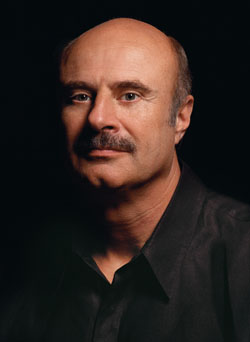
Dr. Phil McGraw: From Cardboard Box to Television’s Doctor of Tough Love
Phillip Calvin McGraw, best known to millions as Dr. Phil, has become a household name in America. His booming voice, no-nonsense advice, and presence on daytime television for over two decades gave him fame and fortune. Yet behind the persona of authority and confidence lies a personal history shaped by hardship, instability, and even homelessness. These early struggles carved the character of the man who would one day sit across from guests and help them untangle their own lives.
A Childhood in Chaos
Phil McGraw was born on September 1, 1950, in Vinita, Oklahoma, the only son among four children. His father, Joe McGraw, worked in the oilfields, but the family’s life was often marked by poverty and unrest. His father battled alcohol, and the home environment was stormy and unpredictable.
Phil has described his upbringing bluntly: “I came and went through the bedroom window so I didn’t have to go through the house. It was total chaos… yelling, screaming, domestic violence.” This sense of disorder left scars but also instilled in him an instinct for survival and a determination to escape his circumstances.
The Descent into Homelessness
As a teenager, McGraw’s home life unraveled further. By age 12, he and his father were living in a car in Kansas City, scraping by while his father tried to find work. At other times, Phil had no shelter at all, relying on the streets. He later admitted publicly: “I’ve been homeless. I’ve lived on the streets of Kansas City… I’ve slept in a cardboard box.”
Few could have imagined that the young boy curled up on cold pavement would one day own homes worth tens of millions of dollars. For Phil, the experience of homelessness was not a passing detail but a profound life marker. It shaped his empathy toward the marginalized while also hardening his resolve never to return to such desperation.
Finding Structure in Sports and School
Despite the chaos, Phil found refuge in athletics. Tall, broad-shouldered, and quick, he excelled in football. His talent earned him a scholarship to the University of Tulsa, where he played middle linebacker. Though his team suffered one of the worst defeats in college football history—a 100–6 loss to Houston—Phil’s athletic career gave him discipline and drive.
Realizing his path lay elsewhere, he transferred to Midwestern State University in Wichita Falls, Texas. There he earned a B.A. in psychology in 1975. He pressed on to the University of North Texas, completing a master’s in experimental psychology in 1976 and a Ph.D. in clinical psychology in 1979. This was a stunning leap for someone who had once slept in a box under the open sky.
A Professional Beginning
After graduate school, McGraw joined his father in private practice. Yet he quickly discovered that the traditional therapist’s office was not his calling. Instead, he partnered with Thelma Box to create a life-skills seminar called Pathways, teaching people to reframe their struggles and regain control. Later, in 1990, he co-founded Courtroom Sciences, Inc., a firm that prepared high-stakes legal teams for trial.
This company would be McGraw’s bridge to national fame. In 1996, Oprah Winfrey hired him to advise her defense team during a highly publicized lawsuit brought by Texas cattlemen. Oprah credited McGraw with helping her win the case, and soon after, he became a regular expert guest on The Oprah Winfrey Show.
Homelessness Remembered
Even after fame arrived, Dr. Phil did not erase his painful past. On several occasions, he reflected on those early days. His candid statement, “I’ve slept in a cardboard box,” stunned audiences, reminding them that his rise was not cushioned by privilege. He also told interviewers that his hardships gave him a perspective few could fake: “When you’ve been there—when you’ve really had nothing—you understand how fragile life can be. It either breaks you or makes you fight harder.”
His willingness to acknowledge this period distinguishes him from many celebrities who sanitize their pasts. By embracing his story, he offers a narrative of resilience to those facing their own crises.
The Dr. Phil Show and Beyond
In 2002, McGraw launched his own syndicated program, Dr. Phil, which combined elements of psychology, tough love, and television spectacle. The show quickly became one of daytime TV’s top performers, drawing millions of viewers. Guests ranged from ordinary people with personal struggles to high-profile celebrities, and McGraw’s direct, uncompromising style became his trademark.
While critics often questioned his methods, fans resonated with his straight talk. The credibility behind his authority was, in part, the lived experience of hardship. People knew he wasn’t speaking from a privileged ivory tower—he had known hunger, fear, and the humiliation of homelessness.
Lessons from the Hard Road
Dr. Phil’s philosophy rests on personal responsibility and facing reality head-on. It is not hard to trace this back to his formative years. In interviews, he has explained: “You can’t change what you don’t acknowledge.” For someone who grew up amid violence, poverty, and instability, acknowledging harsh truths was survival itself.
His empathy for those who feel trapped stems directly from his own moments of despair. Yet he also embodies the counterpoint: the belief that circumstances need not dictate destiny. “You have to decide that being broke, being beaten down, being hopeless is not your future. I decided that sleeping in a box wasn’t my story. And it wasn’t.”
The biography of Phil McGraw is not just about a famous television host; it is the story of a man who rose from the depths of hardship to become a symbol of resilience. From a childhood of domestic chaos to nights spent homeless in Kansas City, his early life was a crucible of suffering. Yet through grit, education, and determination, he rebuilt himself into one of the most recognized figures in American media.
His journey proves that homelessness and hardship, while devastating, can also forge a fierce drive to succeed. Today, Dr. Phil’s voice carries authority not only because of his psychology degrees or television success, but because when he says “I’ve slept in a cardboard box,” people know he has truly walked through the fire—and come out stronger.