
Colonel Harland Sanders: From Drifter to Fried Chicken Legend
Hardscrabble Beginnings
Harland David Sanders was born on September 9, 1890, in Henryville, Indiana. Life dealt him hardship early—his father died when Harland was just five years old. His mother was forced to work long hours at a canning factory, leaving young Harland to care for his younger siblings and prepare family meals. This early necessity sparked his interest in cooking.
By age 12, Sanders left home to work various farm jobs. He had little formal education, dropping out in the seventh grade. Over the next several years, he held a string of jobs—streetcar conductor, railroad fireman, insurance salesman, and steamboat operator—but stability eluded him.
A Life on the Move
In his early adult years, Sanders drifted from one job to another, often traveling and living wherever he could find work. During the Great Depression, times grew even harder. At one point, after losing a job and unable to afford rent, Sanders found himself effectively homeless, sleeping in boarding houses when he could scrape together the money, and occasionally spending nights in his car.
Reflecting on this period, he later said:
“I’ve had more failures than successes. You just have to keep picking yourself up and trying again.”
These years of uncertainty and instability gave Sanders a restless determination. He was never content to sit idle, always looking for the next opportunity, even if it meant starting over yet again.
The Birth of a Recipe
In 1930, at age 40, Sanders took over a Shell filling station in Corbin, Kentucky. To supplement his income, he began cooking meals—fried chicken, country ham, biscuits—for travelers. Word spread quickly, and his reputation as a cook grew. He eventually opened a small restaurant, and in 1936, Kentucky’s governor commissioned him as a “Kentucky Colonel” for his contributions to the state’s cuisine.
Yet even as his restaurant prospered, hardship was never far away. In the 1950s, a new interstate highway bypassed Corbin, devastating local businesses. Sanders was forced to close his restaurant and motel at age 65. He sold most of what he had and found himself, once again, with little more than his car and his vision.
Back on the Road—At 65
Rather than retire, Sanders loaded his car with a pressure cooker, flour, spices, and bags of chicken. He hit the road, traveling from town to town, often sleeping in his car, staying with friends, or renting the cheapest motel rooms he could find. His mission: convince restaurant owners to license his secret recipe for “Kentucky Fried Chicken.”
This period was grueling. Sanders faced hundreds of rejections. “I was turned down more times than I could count,” he later recalled. “But one ‘yes’ made up for all the ‘no’s.”
Living out of his car in his mid-60s was not easy, but Sanders had an unshakable belief in the quality of his chicken and the potential of his idea. “I think a man’s got to try in life,” he once said, “no matter how many times he gets knocked down.”
The Breakthrough
Gradually, the rejections gave way to agreements. Restaurants began adding “Kentucky Fried Chicken” to their menus, paying Sanders a nickel for every chicken sold using his method and recipe. His blend of 11 herbs and spices, paired with his unique pressure-frying technique, produced chicken that was flavorful, crispy, and cooked in less time than traditional methods.
By the early 1960s, the brand was gaining national recognition. In 1964, at age 73, Sanders sold the Kentucky Fried Chicken corporation for $2 million (about $20 million in today’s money) while retaining lifetime royalties and a role as the company’s spokesman.
A Legacy Forged in Struggle
Sanders’s story is often celebrated as a testament to perseverance, but the years of homelessness and uncertainty shaped his outlook as much as his eventual success. He knew what it was to lose everything and start over—more than once—and he built his brand with that same grit.
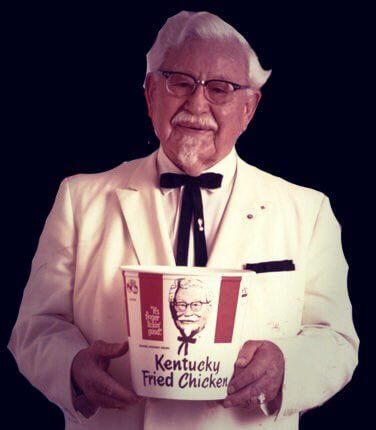
His later public image, dressed in a white suit and black string tie, was a far cry from the man who once slept in his car between business pitches. Yet behind the genteel Southern gentleman was a man who had endured decades of instability, rejection, and near-poverty.
As Sanders once put it:
“I made a resolve then that I was going to amount to something if I could. And no hours, nor amount of labor, nor amount of money would deter me from giving the best that there was in me.”
Final Years and Enduring Influence
Even after selling the company, Sanders remained the face of Kentucky Fried Chicken, traveling the world to promote the brand. He continued to visit restaurants, meet customers, and ensure his standards were upheld well into his 80s.
Colonel Harland Sanders passed away on December 16, 1980, at the age of 90. His journey—from fatherless boy, to drifter, to homeless entrepreneur, to global icon—remains one of the most remarkable in American business history.
His life offers a powerful reminder: success doesn’t always come early, and it rarely comes without hardship. For Sanders, every setback was a setup for a comeback.
Or, as he famously said:
“I’ve only had two rules: Do all you can and do it the best you can. It’s the only way you ever get that feeling of accomplishing something.”