
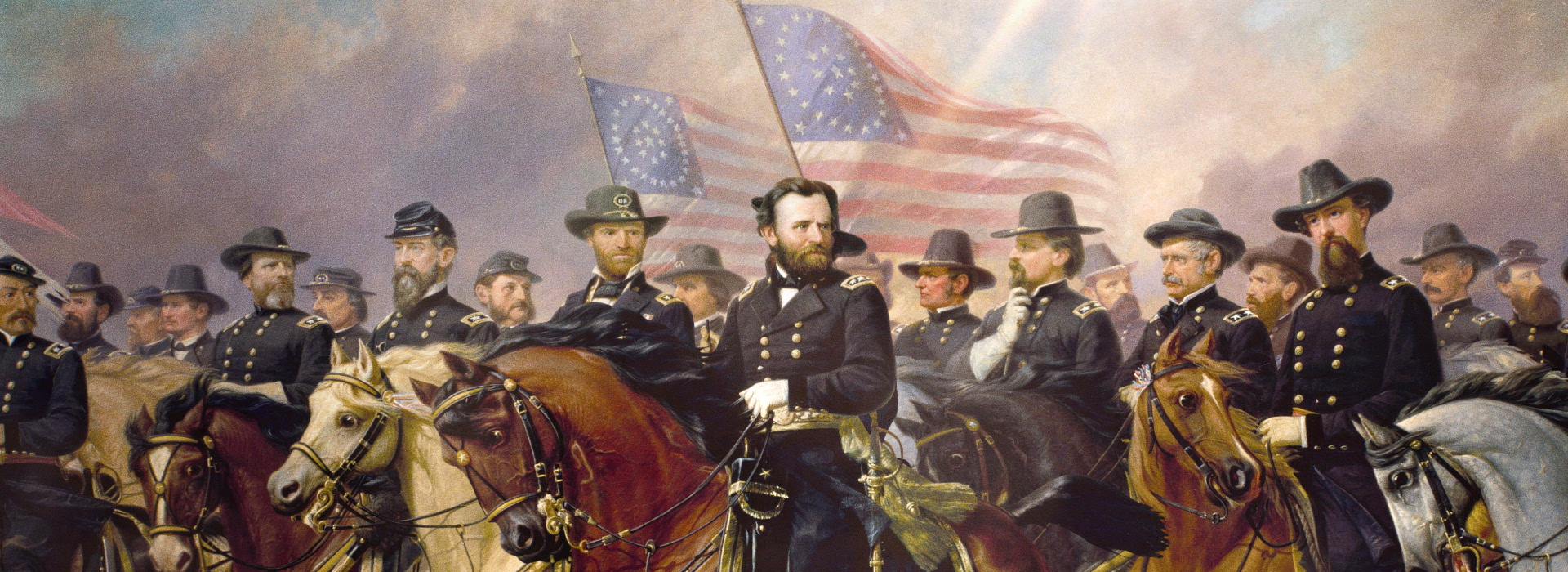

Ulysses S. Grant: From Poverty and Struggle to Union Hero
Ulysses S. Grant, the 18th President of the United States and commanding general who secured Union victory in the Civil War, is often remembered as a stoic leader and reluctant politician. Yet before he rose to prominence, Grant endured poverty, professional failure, and periods of near-homelessness that shaped his resilience and humility. His life demonstrates how adversity can forge character and prepare a man for monumental responsibility.
Early Life in Ohio
Hiram Ulysses Grant was born on April 27, 1822, in Point Pleasant, Ohio, the eldest of six children. His father, Jesse Root Grant, was a tanner and businessman, while his mother, Hannah, was a quiet, devout woman. Though his family was not destitute, Grant grew up in modest conditions.
Grant disliked his father’s tannery work, but he excelled with horses. From a young age, he was hired out to neighbors to plow fields and haul loads, earning money to support the household. Later, he reflected:
“I had an aversion to the trade [tanning], but I did like to work with horses, and that was my joy as a boy.”
These early labors instilled in him a strong work ethic but offered little stability.
West Point and Aimlessness
Grant entered West Point in 1839, largely because his father secured him an appointment. Though he showed skill in horsemanship, he struggled academically, graduating in 1843 near the bottom of his class. Still, he served ably in the Mexican-American War under Generals Zachary Taylor and Winfield Scott, experiences that shaped his view of leadership and warfare.
After the war, military life left him restless. He was stationed far from his family, earning little pay, and his loneliness drove him to bouts of drinking. In 1854, facing rumors of alcohol abuse and discouraged by bleak prospects, Grant resigned from the Army.
Years of Hardship and Poverty
Civilian life proved far harsher. With no steady profession, Grant bounced between failed ventures—farming, real estate, and working in his father’s leather shop. He attempted to farm land given to him by his father-in-law, naming it “Hardscrabble.” The name proved prophetic: the soil was poor, his crops failed, and Grant struggled to provide for his wife Julia and their growing family.
In 1858, financial collapse forced him to sell the farm and move in with his parents in Galena, Illinois. Effectively, the former Army officer was homeless, dependent on his father for a job selling leather goods.
Humiliated, Grant endured whispers that he was a failure. He later admitted:
“I failed at everything I tried, until the war came.”
Civil War and Redemption
When the Civil War erupted in 1861, Grant was working in his father’s store. Though he had been out of the Army for years, he volunteered to serve and quickly rose through the ranks. His calm under pressure, insistence on perseverance, and strategic clarity distinguished him.
His victories at Fort Donelson, Vicksburg, and ultimately Appomattox transformed him from a man once living on the brink of poverty into a national hero. Reflecting on his philosophy of persistence, he wrote:
“In every battle there comes a time when both sides consider themselves beaten; then he who continues the attack wins.”
The lessons of hardship—the endurance of humiliation, the patience through poverty—had hardened Grant for the relentless demands of war.
Presidency and Financial Struggles
After the war, Grant was elected the 18th President of the United States (1869–1877). His administration sought to stabilize the nation during Reconstruction and to protect the civil rights of freed slaves. But scandals among his associates tarnished his presidency, and he left office weary and financially strained.
In the 1880s, after failed investments with his son and unscrupulous partners, Grant again faced financial ruin. He lost his savings and, with cancer consuming him, worried about leaving his family destitute.
Final Hardship and Last Triumph
During his final illness, Grant endured excruciating pain from throat cancer but pushed himself to complete his memoirs, dictated in a cottage in Mount McGregor, New York. His determination was driven by the same instinct that had carried him through poverty years earlier: the need to provide for his loved ones.
He finished the manuscript just days before his death in 1885. Published by Mark Twain, The Personal Memoirs of Ulysses S. Grant became a bestseller, ensuring financial security for his family. Critics praised its clarity and honesty.
Grant’s last words, reflecting his humility, were:
“Let us have peace.”
Lessons from Hardship
Grant’s early struggles—poverty, failed ventures, dependence on others, and brushes with homelessness—deeply shaped his outlook. Unlike many generals and politicians of his era, he bore no airs. He remained modest, often self-critical, and empathetic toward ordinary soldiers and civilians.
Some of his most enduring reflections underscore the lessons hardship taught him:
- “I never held a council of war. I heard what men had to say, and then I made up my mind what to do.”
- “The friend in my adversity I shall always cherish most. I can better trust those who helped relieve the gloom of my dark hours than those who are so ready to enjoy with me the sunshine of my prosperity.”
Conclusion
Ulysses S. Grant’s biography is not simply the story of a general who saved the Union or a president who guided the nation through Reconstruction. It is also the story of a man who knew failure intimately—who endured poverty, humiliation, and near-homelessness, yet refused to surrender.
His resilience in the face of adversity became the foundation of his greatness. As he himself once admitted with characteristic humility:
“Although a soldier by profession, I have never felt any sort of fondness for war. And I have never advocated it, except as a means of peace.”
From his hardscrabble farm to Appomattox, from financial ruin to literary triumph, Grant’s life shows how hardship can temper character and prepare even the humblest man to change history.